How to Translate a Website Contact Page and Reach New Markets
By simply offering a translated contact form on your contact page will make your business be perceived as more open and considerate. Create web forms that translate automatically.
Why reach one audience, when you can reach the world? If your business knows no borders then a website translation service like Weglot, paired with a FormBuilder contact form in each language, makes it easy to welcome visitors in their own language.
If you already know your business attracts a multilingual audience, then you need a multilingual website with the whole contact page translated in order to understand their needs.
But if you think your targeted audience is not diverse and you don’t need to present your business in other languages, you might be missing out on potential customers.
In fact, you might be surprised by how much more prospects would embrace your brand.
By simply offering a translated contact form on your contact page will make your business be perceived as more open and considerate.
Let’s go over the potential market share of multilingual websites and how easy it is to translate a website contact page.
When you pair a translated website with a FormBuilder contact form in the same language, you will be welcoming new customers before you finish counting from uno to diez!
Why you need Translated Websites
Big businesses did not adapt their communication after reaching new markets. They’ve reached new markets because they have adapted to new audiences.
International business or international trade starts small, getting the basics right. Translating an entire website was not a consequence but the very reason why some businesses grew.
“Communication is the key for any global business” Anita Roddick, the founder of The Body Shop once said about the international success of her brand.
But even if you’re not daring to dip your business feet in the overseas water yet, you’ve got to think global – even if your business is local. Why? Because maybe your local patrons are foreigners.
When it comes to growing your business and making revenue, any paying customer matters.
If even big companies have their entire website translated into other languages, why wouldn’t you? Why make prospects adapt to you when you can easily adapt your whole website into their language with automatic translation by Weglot?
Most businesses hire top designers and marketing agencies to help them grow their revenue. Although this investment is justified, multilingual websites are often overlooked and discarded as part of the strategic business plan.
Smarter businesses know that people are searching for their products or services in other languages too. Multilingual SEO has barely been explored even though it’s something simple and it can really boost revenue generation.
Multilingual websites improve SEO results, increasing organic traffic since you’re tackling it with more languages other than English.
A multilingual website goes beyond the ability to communicate in other languages. It provides customer insights and a broader business perspective.
Targeting Multilingual Audiences
A broader perspective starts with looking at beyond what’s known and comfortable to us. It’s about learning what other languages are relevant to your business. Finding out consumer behavior facts from non-English speaking or Limited-English-proficient customers.
Only if you have tried buying something online from a foreign website, you’ll know the discomfort. It is truly frustrating not being able to seek the information you need simply because it is not in your language. You feel not welcomed. You end up quitting it.
Business owners cannot assume everyone who will visit their website speaks English. Even if you plan to offer your products or services in the U.S. only, the American audience is very diverse.
The most spoken languages in the U.S.
America’s “Melting Pot” speaks at least 350 languages, according to the U.S. Census Bureau. Maybe you don’t need to cater to all of them. But providing a contact form in your contact page for at least the main ones is just a sound business decision.
The United States doesn’t have an official language, however, unsurprisingly, English is the most spoken language in the country. But Spanish comes in strong in second place, followed by Chinese, Tagalog (a.k.a. “Filipino”), Vietnamese, and French, as the top six languages.
Keep in mind that depending on your area of service, you might target some other specific language. Like Portuguese, if you’re in Boston, Hindi in L.A., or Italian in New York. Targeted demographics research should provide key insights.
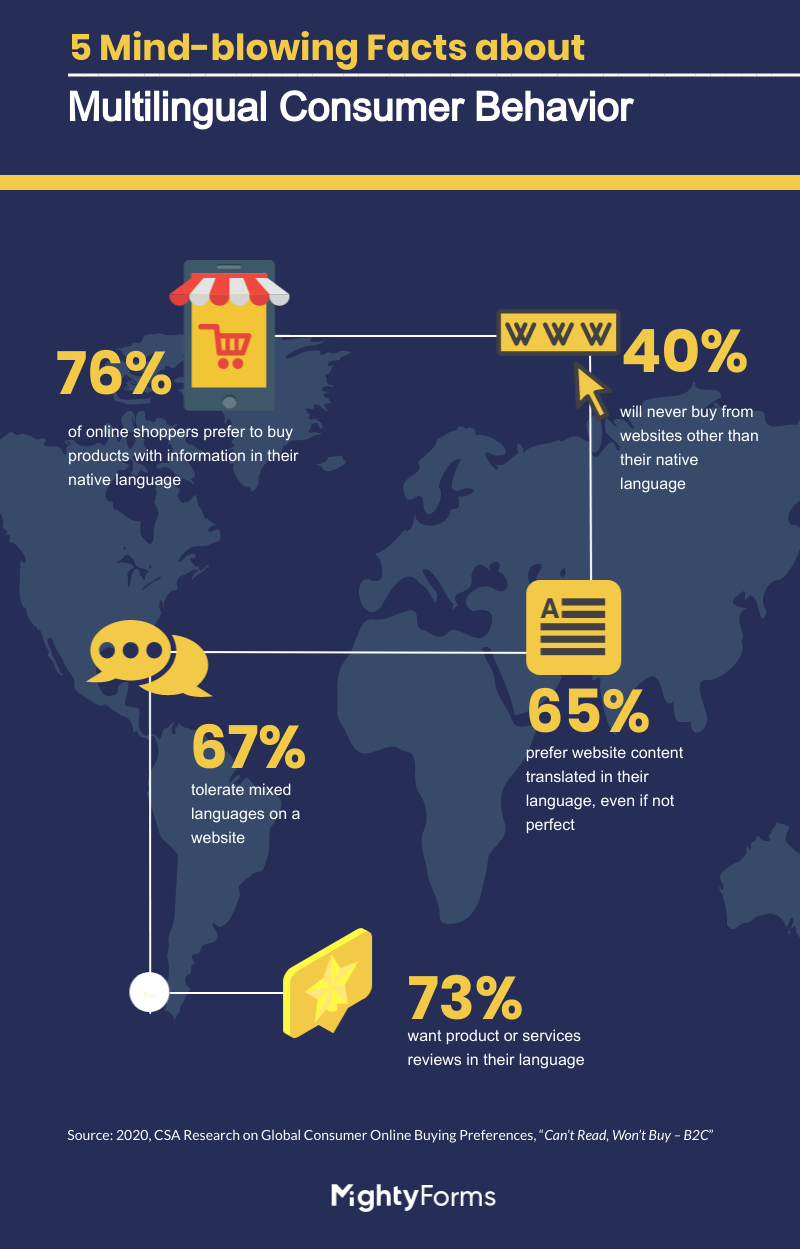
5 Mind-blowing Facts about Multilingual Consumer Behavior
So now we know that English is not the only language widely spoken in the U.S. But it might be surprising to know that English may not be the preferred language when it comes to attracting all prospects.
According to a survey conducted by CSA Research on Global Consumer Online Buying Preferences, aptly called “Can’t Read, Won’t Buy – B2C”, native language matters most.
The findings from this report reinforce the need to translate the entire website in order to promote your business in the language your audience is most comfortable with.
Here’s the main takeaway in five mind-blowing multilingual consumer facts:
-
76% of online shoppers prefer to buy products with information in their native language
-
40% will never buy from websites other than their native language
-
65% prefer website content translated in their language, even if not perfect
-
67% tolerate mixed languages on a website
-
73% want product or services reviews in their language
The data from this survey strongly indicates that when businesses translate the entire website, they acquire more customers. Also, as the research points out “localization improves customer experience and increases engagement in the brand dialogue”.
Customer acquisition and customer experience start at customer attraction, as I have pointed out in another article about the customer journey into lead generation. So, it is only logical that providing your website content in your target audience’s preferred language will trigger the whole process faster and better.
Weglot makes automatic translation very easy, so speaking the preferred language of your customers is just a matter of a few settings.
Multilingual Potential Market
In case you’re still on the fence about multilingual websites, even though we just went over most languages spoken in the U.S. and their consumer behavior, then perhaps their potential market will convince you.
When you translate your whole page, you’re not doing non-English speakers any favors, mind you. Their buying power and influence will practically demand your attention and inclusion.
Consider this buying power by ethnicity in the American economy:
-Latinos or Hispanics make up 18.6% of the U.S. population and 10.7% as their share of buying power, which represents $ 1.7 trillion, behind only by White population. That’s a lot of dinero!
-Asians make up 6.3% of the U.S. population and 7.1% of American buying power, representing $1.2 trillion (have you seen the Crazy Rich Asians movie?).
-Multiracial groups make up 2.8% of the U.S. population and 1.6% as their buying power share, which represents $253.9 billion.
Seriously, have you signed up for a Weglot account yet?
What is Weglot
Long gone are the days of costly manual translation of your entire website.
A professional translator (an actual human) can help you with very specific jobs, like a technical manual or a business contract. And a human translation can definitely help with creative translation jobs, where context and nuance knowledge are required.
But if you’re looking for an automatic translation of your entire website, a whole page or even a contact form for your contact page, then Weglot is by far the smartest approach.
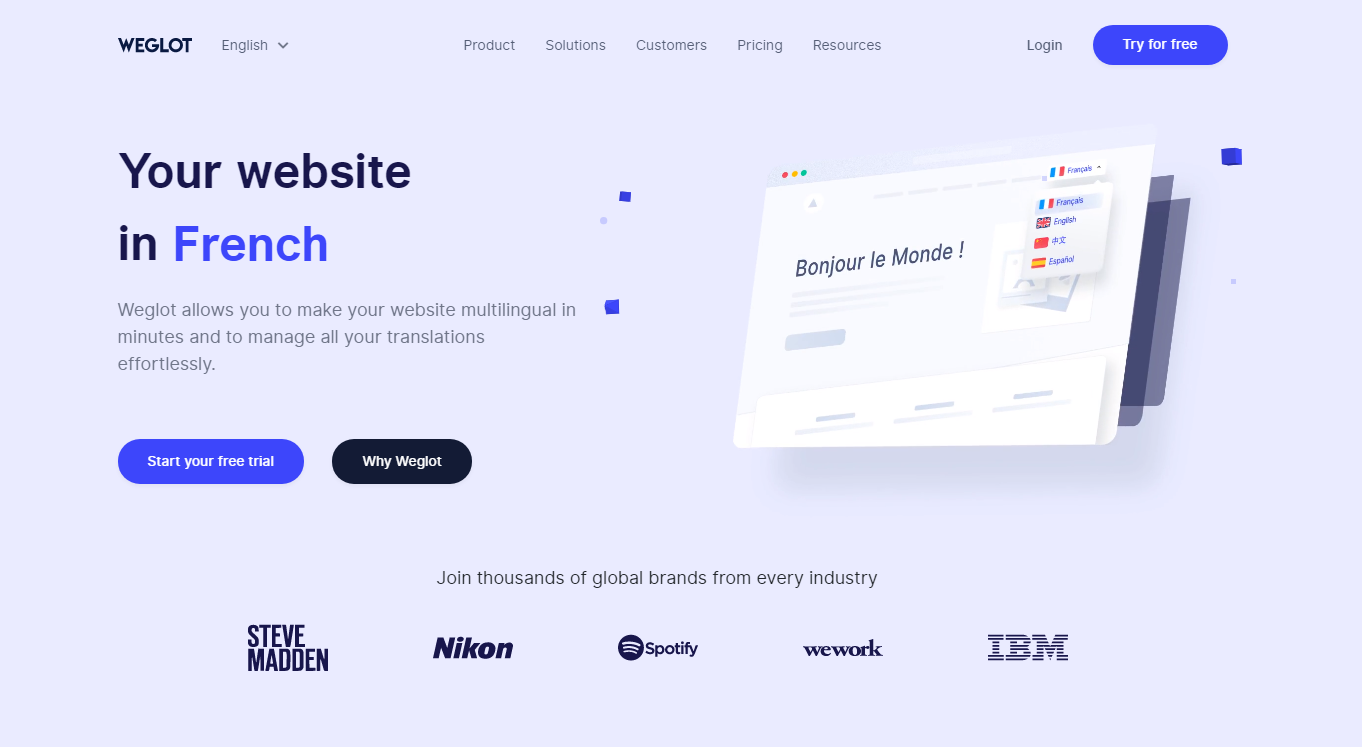
Weglot can get the job done in multiple languages, so you can connect to your diverse audience with multilingual websites in no time. And nothing is lost in translation, not even one single lead (wink-wink).
How Weglot works
Weglot is one of the leading translation solutions for websites. And just like FormBuilder, it works without any coding knowledge required.
Weglot is compatible with all Content Management Systems (CMS) like WordPress, Shopify, Squarespace, BigCommerce, Wix, etc. This means your translated content will be displayed exactly like the original language layout.
The automatic translation process takes a few minutes and voilá, your multilingual website is ready.
You’ve probably visited a website with a language selector. Some list the available languages on a dropdown menu or show flag switcher buttons on top. That’s how simple it will be for your visitors to switch to the desired language.
The difference of Weglot from a machine translator, like Google Translate, for instance, is that it combines different technology and human support to deliver the most accurate translation. And it lets you easily edit any section manually or customize pages if needed.
How to Translate a Website Contact Page
Now that we’ve settled on Weglot for entire website translations, let’s also nail right the centerpiece of your website contact page: the contact form.
Contact forms by FormBuilder are easy to build, fully responsive, customizable, and automated, packed with features and functionalities that go way beyond collecting information.
From the FormBuilder form builder dashboard, you can design your contact form from scratch or from a template. There’s even a nice optimized contact form template selection pack that gives you a head start.
You can edit and customize your contact form any way you want. Resize and reposition fields, change color scheme and fonts, add your own logo and background.
If you’re not sure how a contact form is supposed to look and work, we’ve previously covered some of the best contact page examples and best practices.
As I’ve mentioned, you can then enable further settings to leave your contact form on autopilot, working as a truly reliable client intake tool.
Get email notifications of new submissions, send responses straight to Google Sheets, show a thank-you page after completion, and much more.
How to add a translated contact form to your translated page
Once your contact form is ready to go in its default language (English), it’s time to match it to each translated version of your contact page.
Bear in mind that a form embedded in an iframe is not translated by your website translation tool, since the form content is loaded from FormBuilder rather than from your page. The simplest reliable approach is one form per language:
Step 1. Build your English contact form in FormBuilder and check that it works the way you want.
Step 2. Duplicate the form for each language you support and translate the field labels, placeholder text, button text, and thank-you message. Keep the field structure the same so the responses line up in one place.
Step 3. Publish each form and copy its embed snippet.
Step 4. In your website builder, open each translated version of the contact page and embed the form in the matching language. If your translation tool lets you exclude a block from translation, exclude the form embed so it is not double-translated.
Step 5. Set up email notifications or a Google Sheets connection on each form so every language feeds the same follow-up process.
Your translated contact page now includes a contact form in the same language as the rest of the page. Cool, huh?
There you have it! Weglot makes automatic translation of entire websites possible and a FormBuilder form in each language keeps your contact form matching the rest of your contact page. Multilingual websites have the power to enhance your brand so you can reach new markets. Be understood and embraced by new prospects. Collect contact information in any language with FormBuilder and Weglot!